
Vimavidya
PROPERTY
Property Insurance

Wake-Up Stories — Real India, Real Losses
Numbers teach the mind. Stories reach the heart. These narratives are examples from real scenarios across India

Your landlord’s policy stops at the walls - Tenant’s contents cover
Sandeep, 29, and Prathima, 27, newly married, had carefully furnished their 2BHK rental flat in Pune from their savings — refrigerator, smart TV, washer-dryer, a full home office setup. The total value of everything they owned inside that flat: ₹3.5 lakhs.
One morning, a short circuit in the building's common meter box triggered a fire that spread to three flats. Their washing machine and entire home office setup were destroyed. Sandeep called the landlord — who did have a policy. But that policy covered only the building's insured structure: the walls, roof, and floors. It did not — and legally cannot — extend to a tenant's personal belongings.
Sandeep and Prathima had no policy of their own. There was no contents cover to replace their electronics. No fire peril protection on their belongings. They replaced what they could on a credit card and spent the following year repaying the debt.
Later, they discovered that a tenant's contents policy covering ₹3.5 lakhs of belongings would have cost them approximately ₹3,000–₹4,500 a year in premium — less than ₹400 a month. Because they lived in a rented home, they had full insurable interest in everything they brought into it. The landlord's insurance was never designed to cover Sandeep and Prathima. Only they could do that — and they hadn't.
Takeaway : A tenant's contents policy is not the landlord's responsibility — it is yours. Whether you own the four walls or simply live within them, the belongings inside belong to you, and only a policy in your name can protect them.
One night of a natural disaster can erase years of savings - waiting without cover
Ramamurthy, 63, had lived in his Vishakhapatnam house for 35 years. In all that time, nothing serious had happened — no fire, no flood, no break-in. Each year, when the thought of insurance crossed his mind, the logic felt sound: why pay for something that never comes? Over 35 years, he had saved approximately ₹1,40,000 by not paying premiums.
Cyclone Hudhud did not announce itself with enough warning for Ramamurthy to reconsider. The roof was partially torn off. The compound wall collapsed. Rain entered through the damaged structure and destroyed his television, his late wife's sewing machine, and his daughter's computer. The storm took one night. The damage was total.
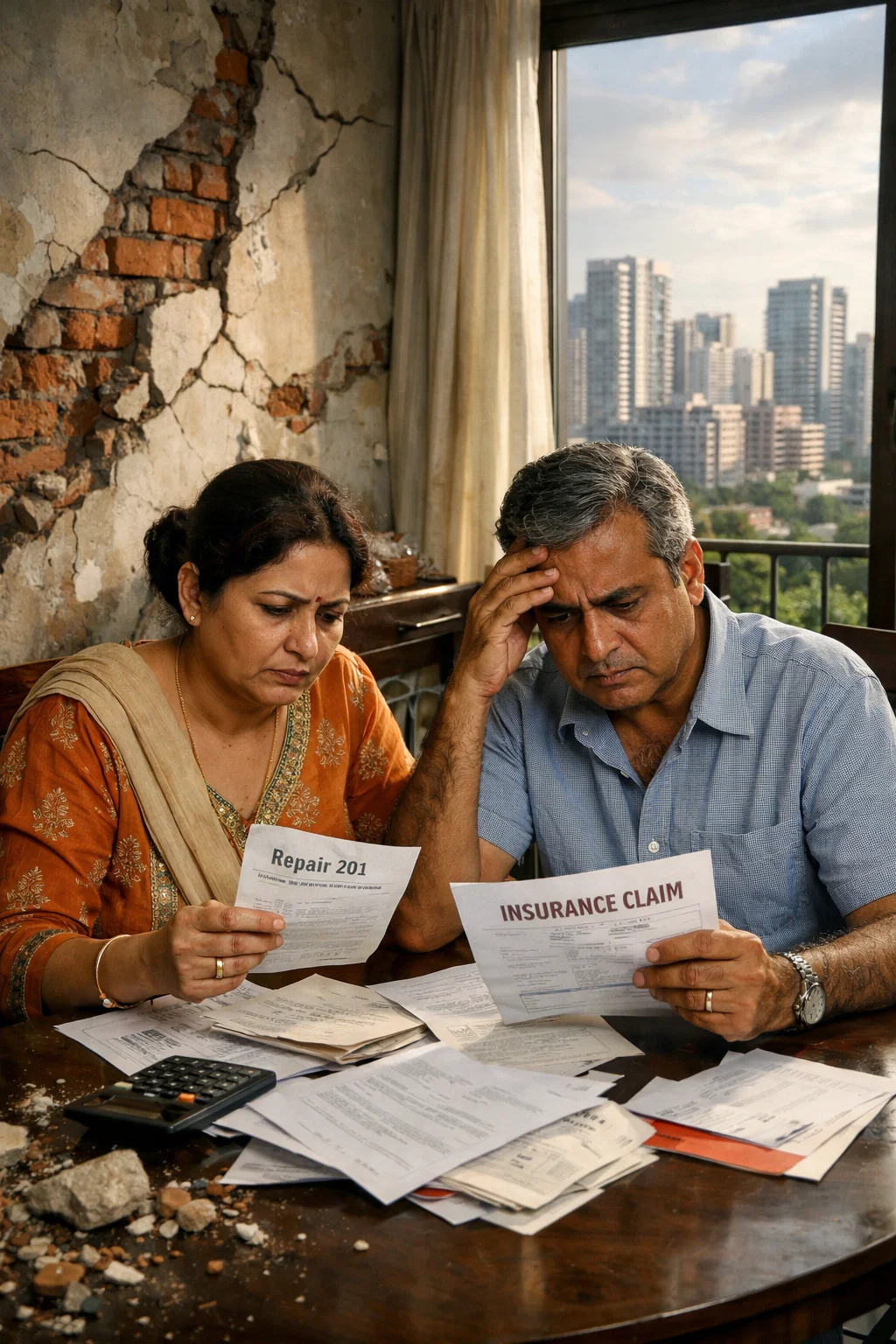
Rebuilding the structure cost ₹4 lakhs. Replacing the compound wall cost ₹80,000. Replacing the destroyed contents added ₹1.2 lakhs. The total loss came to ₹6 lakhs. Ramamurthy, retired and on no regular income, borrowed from his son and a nephew.
A standard home insurance policy would have listed cyclone as a named peril — one of the specific risks explicitly covered under the policy. Structural damage from a named peril triggers the building cover; belongings destroyed as a direct consequence are covered under contents cover. A comprehensive policy covering both the structure and contents at the correct reinstatement value would have cost approximately ₹4,000 a year. Over 35 years, that is ₹1.4 lakhs in premiums — the exact amount Ramamurthy had saved by going without.
'I saved ₹1,40,000 over 35 years by not paying premiums,' he said. 'I lost ₹6 lakhs in one night.'
Takeaway : The absence of a past loss is not evidence that a future loss won't come. Cyclones, earthquakes, and floods are named perils covered under standard Indian home insurance policies. The premium is the price of certainty — paid in small amounts every year so that one night cannot undo a lifetime of building.


Unlisted jewellery is worth only ₹50,000 on paper - Why declaring your jewellery matters.
Farrukh and Shahina, both in their forties, owned a flat in Andheri West and had what they believed was a solid home insurance policy — ₹70 lakhs covering the structure, and ₹8 lakhs in contents cover. They felt protected.
During a three-week visit to their native place, their flat was burgled. Shahina's gold jewellery — accumulated piece by piece over 15 years of festivals, anniversaries, and family gifts — was worth approximately ₹9 lakhs. The television, laptop, and camera were also taken. Total loss: over ₹11 lakhs.
When they filed the claim, they discovered something buried in the policy's fine print: jewellery is subject to a sub-limit. Unless individual pieces are formally declared as specified items, the insurer's liability for jewellery is capped — in their case, it was ₹50,000. Their ₹9 lakh accumulation was valued by the insurer at fifty thousand rupees.
The remaining contents claim — the electronics — was partially accepted. They received a total payout of only ₹2.3 lakhs against a loss of over ₹11 lakhs. They bore ₹8.7 lakhs out of their own pocket.
Had Shahina's jewellery been listed item by item, valued by a professional, and declared as agreed value specified items in the policy schedule, the insurer's liability would have matched the actual loss. The additional premium for declaring ₹9 lakhs of jewellery would have been a few hundred rupees a year. The paperwork — a valuation certificate — takes an afternoon.
Takeaway : A contents policy does not automatically cover jewellery at its full value. Every significant piece must be declared, professionally valued, and listed as a specified item — before the loss occurs, not after. The sub-limit exists whether you know about it or not.
If your laptop moves, its insurance cover must too - Electronics cover
Nikhita, 23, a management student in Bengaluru, owned a MacBook worth ₹1.4 lakhs — a gift from her parents, saved up over months. She lived in a paying-guest accommodation near her college and carried her laptop everywhere: to class, to the library, to group study sessions.
One evening, a manufacturing defect in her charging cable caused a small electrical fire at her study table. The MacBook's screen cracked from the heat and it was irreparable.
Nikhita assumed nothing could be done. She was a tenant in a PG, not a homeowner. She had no policy. She didn't know that insurance products exist precisely for someone in her situation. A portable equipment cover would have insured her MacBook both inside and outside the PG — at her college, in a café, on a bus. An Electronic Equipment Insurance (EEI) add-on would have extended protection to include electrical and mechanical breakdown, not just theft or physical damage. Together, the annual premium for ₹1.4 lakhs of cover would have been approximately ₹2,500–₹4,000 — less than ₹350 a month.
She bore the full ₹1.4 lakh loss. Her parents bore it with her.
Takeaway : You do not need to own a home to insure what you own. Portable Equipment cover and EEI are designed for students, young professionals, and renters who carry expensive electronics. The cover travels with the device — not just the address.

Market value misleads — rebuild cost is what counts. - Sum insured vs. rebuilding cost
Harinder and Simran bought their 2BHK flat in Dwarka, Delhi in 2015 for ₹45 lakhs. They took a home insurance policy the same year and set the sum insured at ₹45 lakhs — matching it to what they had paid. It felt logical but it was not.
Harinder and Simran bought their Dwarka flat in 2015 for ₹45 lakhs — a price that included the land, the location premium, and the structure. They insured it for ₹45 lakhs, equating the sum insured to their total purchase price. This was their first mistake: insurance covers only the cost to rebuild the structure — walls, roof, floors, fixtures — not the land beneath it or the location premium embedded in the purchase price. The portion of their ₹45 lakh payment that was attributable to the structure alone was already lower. They had started with an insufficient figure. Over the next seven years, construction costs across Delhi NCR rose by over 40%. By 2022, the actual reinstatement value of their structure — what it would cost to rebuild it from scratch at current rates — had risen to approximately ₹75 lakhs. Their policy's sum insured had not moved. Meanwhile, the property's market value (including land) had perhaps touched ₹1.2 crore. But that number meant nothing to their insurer. Insurance responds to the cost to rebuild, not the price a buyer might pay.
In 2022, an earthquake tremor caused partial wall collapse. Repair cost: ₹18 lakhs. Their insurer applied the average clause — a standard contractual provision that reduces a claim proportionally when a property is under-insured. The calculation: ₹45L (sum insured) ÷ ₹75L (actual reinstatement value) × ₹18L (loss) = ₹10.8 lakhs paid. Harinder and Simran had to arrange the remaining ₹7.2 lakhs themselves.
Had they opted for an escalation clause at inception, their sum insured would have adjusted automatically each year in line with rising construction costs. The additional premium for keeping their cover correctly calibrated: approximately ₹1,200 more per year over seven years.
Takeaway : Your home's market value rising does not protect you. Only your sum insured being correctly aligned to the reinstatement value of the structure does. Review it at every renewal — and consider an escalation clause so it keeps pace with construction costs automatically.